• Home
  • Counseling
    • What to Expect & FAQs
    • About Counselor
    • Success Stories
    • Christian Counselor Certification Course
  • Resources
    • Healthy Resources
    • Women's Bible Study
    • Podcast
    • The Healthy Christian Cookbook
    • Shop Store
  • Book Session
  • Donate
HOLISTIC CHRISTIAN THERAPIES
  • Home
  • Counseling
    • What to Expect & FAQs
    • About Counselor
    • Success Stories
    • Christian Counselor Certification Course
  • Resources
    • Healthy Resources
    • Women's Bible Study
    • Podcast
    • The Healthy Christian Cookbook
    • Shop Store
  • Book Session
  • Donate
Picture

Addiction

According to Jimmy Monaghan from Celebrate Recovery (who has a Clinical MA in Counseling Psychology), addiction is the “occupying of oneself with, or involving oneself in, something habitual or compulsive. Engaging in a behavior, or the ingestion of a substance, that creates life unmanageability.” Addiction, at its root, is a spiritual issue and a bad habit. It is an act of rebellion which has become habitual and ritualistic which over time can develop into a physical dependency. In this lesson you will learn more about the cycle of addiction and ways to heal and break free once and for all. To complete this lesson read the material in the white block, print and go through the scripture study, watch the video teachings, and answer the questions at the end for further discussion in your next counseling session.
Addiction

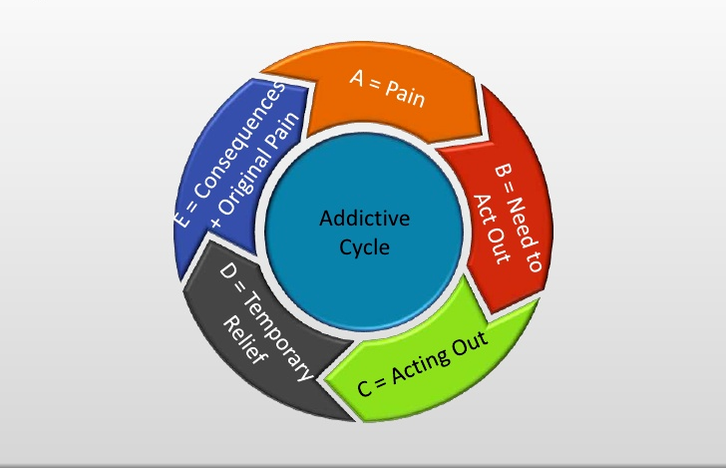
Active addiction is when a person continually uses/engages in something unproductive and ungodly to soothe the inner pain/fear/conflict he or she feels. This offers a "quick hit" of temporary relief or escape. This relief will last only until the original pain/fear/conflict is felt again, then the need to soothe or escape (experienced as a craving) reoccurs, keeping the cycle of addiction going (see Illustration 1 below). Those struggling with addiction often times have a "love void" in their hearts resulting from not being grounded in God's love which they attempt to "fill" with their addiction. This emptiness, pain, or love void is the place where God's love needs to move in, fill, and satisfy rather than the addiction which is an unsatisfying counterfeit version of God's love.
 
Addictions can take on many forms, such as:
  • Food addiction
  • Video gaming addiction
  • TV, YouTube, Internet addiction
  • Social addiction (craving to be socializing)
  • Gossip addiction
  • Thinking addiction (negative thinking or over thinking)
  • Knowledge addiction (craving to know more)
  • Alcohol and drug addiction
  • Sex addiction (lust, promiscuity, and affairs)
  • Pornography addiction (whoremonger, uncleanness in the heart - Ephesians 5:5)
  • Love and relationship addiction
  • Anger addiction
  • ​Approval addiction
  • Work addiction
  • Gambling addiction
  • Shopping addiction
  • Exercise addiction
  • And so on​

​Cycle of Addiction

The cycle of addiction usually progresses through the following stages:
  1. Pain/Fear/Conflict (emotional trigger)
  2. Need to act out (cravings)
  3. Acting out (using or engaging in addictive behavior)
  4. Temporary relief (the "quick hit")
  5. Consequences and guilt, PLUS the original pain
Illustration 1 - Cycle of Addiction
Picture
How Do I Know If I Have an Addiction? 

One way to litmus test this is to ask yourself, "If I were to stop this behavior for 1 week do cravings arise?" If yes, then you are addicted. If no cravings arise, then you are not addicted.

People struggling with addictions often have one or more of the follow areas of challenge:
  • Low-self esteem
  • Difficulty receiving and experiencing God's love
  • Excessive negative self-talk, unhealthy inner self-dialogue
  • Unforgiveness, most often toward self
  • Identity ignorance or confusion
  • Lack of purpose/boredom
  • A rejection mindset
  • Pattern of habitual sin, not submitting to God (1 Cor. 10:13)
  • ​Codependency
  • Feeling out of control
  • Lack of boundaries and difficulty being assertive​
  • Unhealed trauma
  • Ignorance of God's word

If you are struggling with addiction, it is important to identify and resolve the root cause of your pain/fear/conflict. It is this pain/fear/conflict that is keeping the addiction cycle going. Healing the brokenness in your heart and renewing your mind with the truth of God's word will cause the "need to relieve the pain" by means of addiction to gradually fall away. The more you are grounded in God's love, learn how to love and treasure yourself, walk in your new identity in Christ, and let Christ live in you and through you the less you will want to engage in destructive habits and behaviors.

Behavior modification is also part of the healing journey. However, just telling yourself not to do something you want to do doesn't work - this will usually make you want to do it more! Using the "push method" can be beneficial. This is where you focus on adding healthy habits to your life that will "push out" the destructive habits. We see an example of this in Philippians 4:8, "Finally, brethren, whatsoever things are true, whatsoever things are honest, whatsoever things are just, whatsoever things are pure, whatsoever things are lovely, whatsoever things are of good report; if there be any virtue, and if there be any praise, think on these things." This verse tells us to focus our attention on what is true, honest, just, pure, and virtuous; encouraging us to focus on what we "do want" rather than on what we "don't want".

Another helpful thing to remember is never refer to yourself as an addict! Many struggling with addiction believe their addiction defines them. This is one of the major blocks to recovery and is something you will want to break free of. If you are struggling with addiction, your addiction is NOT who you are, nor is it a disease. It is a spiritual issue and a bad habit that you need to stop engaging in and submitting to. Assuming you are a Christian, then in Christ you are a child of God and a member of the Body of Christ. Thus, it is important to renew your mind with this truth and get grounded in your identity in Christ. See the New Identity "in Christ" Graphic below.


Steps For Breaking the Addiction Cycle:
  1. Address the root cause of original pain/fear/conflict
  2. Get rooted in God's love
  3. Adress the spiritual issues (see below)
  4. Cultivate healthy self-esteem and self-love
  5. Create a plan for practicing healthier habits and behavior modifications

Addiction is a Spiritual Issue

​​Scripture teaches us that the moment we are saved (when we first trusted in the gospel of grace) our spirit was quickened (brought to life from the dead) "in Christ". We further learn that it is the Holy Spirit that renews us (Titus 3:5), and it is only after we are saved that we can understand the things of God and walk in the Spirit. In contrast, an unsaved person is still spiritually "dead", only carnally minded, and walks after the course of this world. Breaking free from addiction will mean getting grounded in the love of God, walking in who you are "in Christ, getting stablished in the doctrines of grace, and being renewed in the spirit of your mind. As you do this, the more you will walk in the Spirit and less in the flesh (less in your addiction).

Scripture Study

The scripture study below takes a deeper dive into Ephesians 4:17-24 and outlines how we are to "put off the old man" and "put on the new man" and walk worthy of our calling in Christ. But what does this mean and how do we do this? Print the document below and read through each of the listed cross-reference verses in your Bible to gain a better understanding. Take notes for discussion in your next counseling session. 
Your browser does not support viewing this document. Click here to download the document.
Picture

Video Teachings

Assignment

Questions for Contemplation

In your notebook or journal, answer the following questions:
  1. What is the root pain/conflict/fear in your heart causing you to act out in addiction?
  2. Do you feel loved by God? If not, why?​
  3. Do you struggle to "put on" Christ and walk in your identity in Christ? If so, why?
  4. Are you currently holding unforgiveness, anger, or resentment in your heart towards yourself, others, or God?
  5. Do you find yourself making excuses for your addiction? If so, what are those excuses?​
  6. What did you find most helpful from this lesson?
  7. What is one thing you can do to help yourself break free from addiction?
If this is an emergency, please call:
SUICIDE HOTLINE:  Dial 988
ABUSE HOTLINE:  (800) 799-7233
​ADDICTION HOTLINE:  (800) 662-4357
SEXUAL ASSAULT:  (800) 656-4673
​​MENTAL HEALTH:  (800) 950-6264
SUPPORT FOR VICTIMS OF TRAFFICKING:  (678) 336-2410
​© COPYRIGHT 2015. ​ALL RIGHTS RESERVED
Stephanie Stanton, H.H.C. 
Cell/Text: (201) 892-3959
Email: [email protected]
​
Located in South Florida and the Ozarks

Hours: Monday-Friday, 10 AM-6 PM EST
​Zoom or phone sessions available
​
  • Home
  • Counseling
    • What to Expect & FAQs
    • About Counselor
    • Success Stories
    • Christian Counselor Certification Course
  • Resources
    • Healthy Resources
    • Women's Bible Study
    • Podcast
    • The Healthy Christian Cookbook
    • Shop Store
  • Book Session
  • Donate